
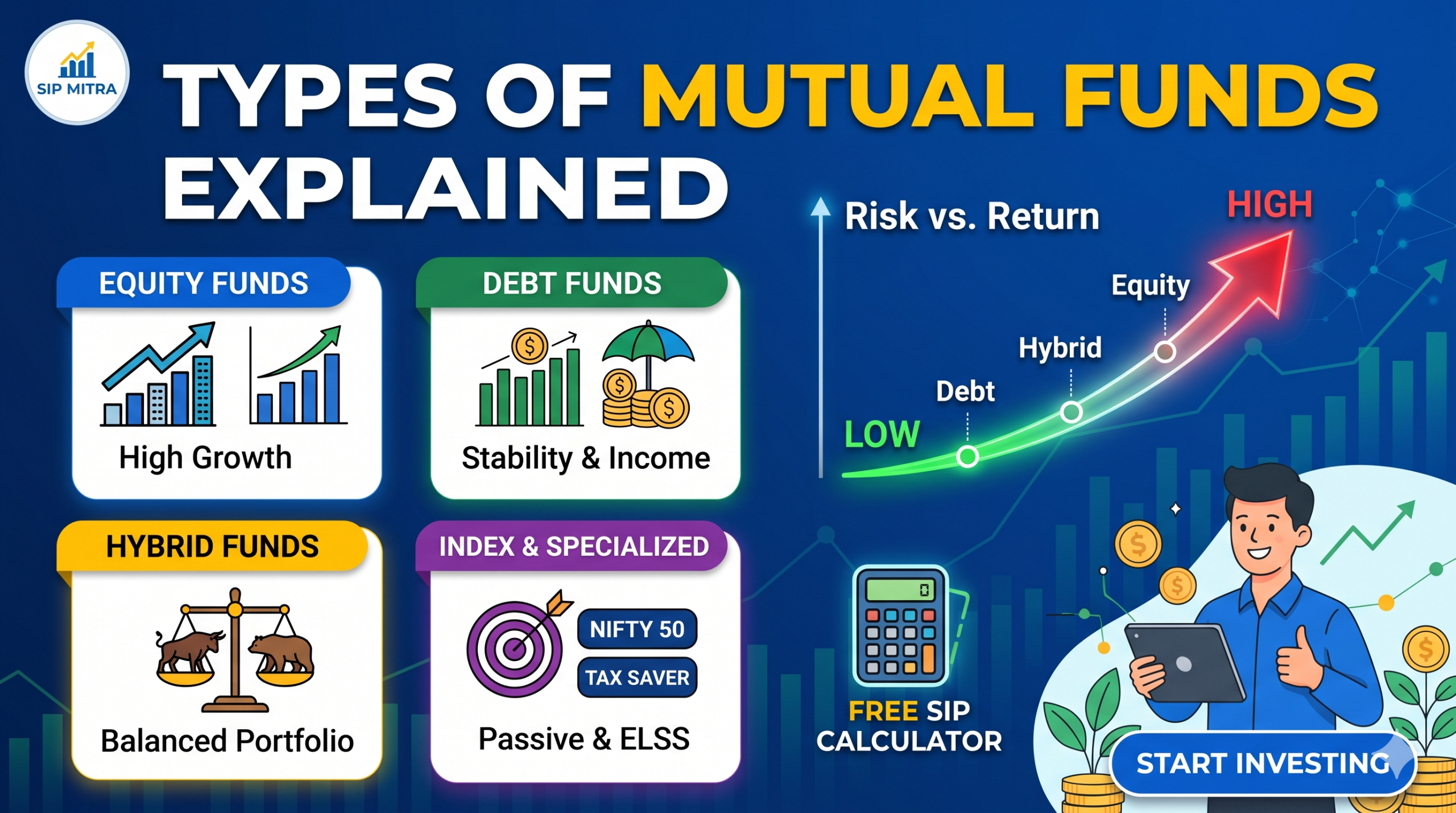
Types of Mutual Funds Explained: Complete Beginner Guide (2026)
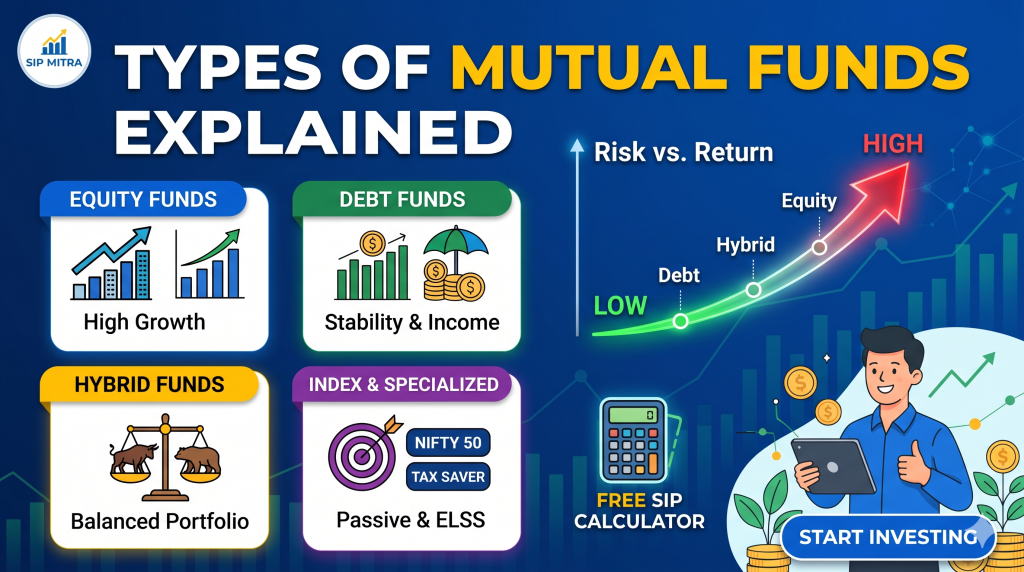
Types of Mutual Funds Explained: The Definitive Investor’s Guide
Navigating the world of investments? We break down every category to help you choose the right fund for your financial goals.
In the complex landscape of modern finance, having the types of mutual funds explained simply can be the difference between a stagnant bank account and a thriving wealth-building engine. Whether you are planning for your child’s education, your retirement, or your first home, understanding the various flavors of mutual funds is the crucial first step.
Mutual funds are not a one-size-fits-all product. They are versatile instruments designed to meet diverse financial objectives, risk appetites, and investment horizons. In this exhaustive guide, we will peel back the layers of equity, debt, hybrid, and specialized funds, ensuring you have the clarity needed to invest via SIP Mitra with confidence.
Table of Contents
What is a Mutual Fund?
Before diving into the types of mutual funds explained, let’s establish the basics. A mutual fund is a professionally managed investment scheme that pools money from many investors to purchase securities. These securities could be stocks, bonds, or short-term debt.
1. Equity Funds: The Growth Engine
Equity funds primarily invest in the stock market. If your goal is long-term wealth creation (5+ years), these are your best bet. Under the umbrella of types of mutual funds explained, equity is often the most discussed due to its high return potential.
Invest in India’s top 100 companies (Reliance, HDFC, TCS). Stable and less volatile.
Risk: Low to ModerateHorizon: 3-5 Years
Invest in companies ranked 101-250 by market cap. High growth potential but higher risk.
Risk: HighHorizon: 5-7 Years
Invest in emerging companies beyond the top 250. These are the “Multibaggers” of tomorrow but can be very volatile in the short term. Essential for aggressive portfolios.
Start Small Cap SIP2. Debt Funds: The Stability Anchor
When looking at the types of mutual funds explained for conservative investors, Debt funds take center stage. These funds invest in fixed-income securities like Government Bonds, Corporate Bonds, and Treasury Bills.
- Liquid Funds: Park your surplus cash for a few days to months. Better than a savings account.
- Gilt Funds: Invest purely in government securities. Zero default risk.
- Corporate Bond Funds: Invest in high-rated corporate debt for slightly better returns than FD.
Risk vs Return Profile: Debt Funds
Generally safe, but subject to interest rate risks and credit risks.3. Hybrid Funds: The Best of Both Worlds
Can’t decide between Equity and Debt? Hybrid funds solve this. They invest in a mix of both asset classes to balance risk and reward.
Balanced Advantage Funds (BAF)
These funds dynamically manage the equity-debt ratio based on market conditions. They buy more equity when markets are cheap and sell when markets are expensive.
4. Specialized Funds: Index & ELSS
Index Funds (Passive Investing)
Index funds replicate a market index like Nifty 50 or Sensex. Since there is no active stock selection by a manager, the expense ratio is extremely low. This is perfect for beginners who want market-linked returns without the stress of picking “the best” fund.
ELSS Funds (Tax Savers)
Equity Linked Savings Schemes (ELSS) are the only mutual funds that offer tax benefits under Section 80C (up to ₹1.5 Lakh). They have a mandatory lock-in period of 3 years, which is the shortest among all 80C options.
SIP Wealth Calculator
See how much you can grow your wealth with consistent investing.
Mutual Fund Types Comparison
| Fund Type | Risk Level | Ideal Duration | Avg. Return |
|---|---|---|---|
| Equity (Small Cap) | Very High | 7+ Years | 15-18% |
| Equity (Large Cap) | Moderate | 3-5 Years | 12-14% |
| Debt Funds | Low | 1-3 Years | 6-8% |
| Hybrid Funds | Medium | 3+ Years | 10-12% |
Read more on our blog: SIP vs Lumpsum: Which is better? and Top 5 ELSS Funds to Save Tax.
FAQs on Types of Mutual Funds Explained
Expert Advice?
Get a personalized mutual fund portfolio created by our experts.
Book Free ConsultationPopular Categories
- High Growth Funds Equity
- Tax Saving ELSS
- Safe Returns Debt
Join 10,000+ Investors
Partner with SIP Mitra and AssetPlus for a seamless investment experience.
Create Account